


Irene is a gifted and thought-provoking speaker.
The content of her lectures always elicits insightful
audience questions and discussion that continues
after the program has ended. It is a privilege
to have an ongoing relationship with Irene and we
look forward to future presentations.
--Melody J. Curtis
Sr. Program Coordinator
The Smithsonian Associates
'
Your presence at the conference impacted significantly and for that
I extend my personal thanks.
David P. Fridovich
Brigadier General, USA
Commanding

Crichton
Event
Announcement

Click to View
Click to View
Click to View

Click to View
News Releases | Events/Announcements
Chaos, Complexity & Public Policy: Interview Available
The Center's director, Irene Sanders, was a guest on dialogue, the award-winning radio and TV program of the Woodrow Wilson International Center for Scholars in Washington, DC. In this wide-ranging 30 minute interview, she and program host, John Milewski, covered a range of topics from the economy to cyber security to nuclear proliferation, all designed to demonstrate the usefulness of complexity science to strategic thinking, foresight development and national security. To see the program, click here
The Center's executive director, Irene Sanders, has been named to the Editorial Board for the International Journal of Complexity in Leadership and Management (IJCLM). IJCLM is an international peer-reviewed journal. It aims to promote a deeper comprehension and to provide dialogue across country borders and cultures on the issues of complexity in leadership and management. In this respect, it aims to serve as a platform where new philosophies, theories, empirical research findings and case studies can be published and shared internationally. For more information: www.inderscience.com or contact Irene at info@complexsys.org
Center's Executive Director to Speak in Singapore
Center director Irene Sanders will speak on the opening day of the International Risk Assessment and Horizon Scanning Symposium IRAHSS, which will be held October 13-14, 2008 in Singapore.
The Symposium is being sponsored by the Centre of Excellence for National Security and the National Security Coordination Secretariat. Her presentation will describe a new complexity-based framework for strategic thinking and planning. For more information, click here.
Book Announcement
New Urbanism and Beyond: Designing Cities for the Future
Best defined as the art of shaping the built environment, urban design seeks to understand and analyze the variety of forces—social, economic, cultural, legal, ecological, and aesthetic—that affect how we live. The complex challenges facing cities today—scarcity of resources, growing economic divisions, and rampant sprawl, among others—are forcing a reconsideration of urban design. New Urbanism, a leading movement within urban design, advocates a return to small-town urban forms: human-scale, pedestrian-friendly streets, a reinvigoration of cities, and a stop to suburban sprawl.
This new volume, drawing on a conference and debates at the Royal Institute of Technology in Stockholm, Sweden, comprehensively examines New Urbanism today and speculates about it’s future. New Urbanism and Beyond is both a comprehensive primer on urban design and a provocation for practitioners, historians, and citizens everywhere. The Center's executive director, T. Irene Sanders, is a contributing author with her essay entitled, "Complex Systems Thinking and New Urbanism." A PDF file of her essay can be found by clicking here.
The book's editor, Tigran Haas, is the Assistant Professor of Urban Planning and Design at the School of Architecture and the Built Environment, Royal Institute of Technology in Stockholm. Published by
Rizzoli/New York.
Creating a Sustainable Future in a Complex WorldOn October 27th Irene Sanders, the Center's executive director, participated in a symposium sponsored by The Smithsonian Associates and the Institute for Defense Analysis. She talked about the impact of complex systems research on the role of foresight in intelligence analysis and intelligence-led policy development.
Center’s Executive Director to speak at workshop sponsored by the Director of National Intelligence and the U.S. Army War College
Irene Sanders will be the closing-day keynote speaker for the Second Annual Proteus “Futures” Academic Workshop---Creative Strategic Intelligence Analysis and Decision Making within the Elements of National Power—being sponsored by the U.S. Army War College and the Director of National Intelligence, and held at the Center for Strategic Leadership, Carlisle Barracks, PA. The workshop will explore complexity in the future global security environment and its discrete threats and opportunities. It will also examine Proteus related new and innovative concepts, strategies and processes to meet 21st century United States national security challenges. For more information visit:
https://www.carlisle.army.mil/proteus/workshop/
Complex Systems Research and Intelligence Analysis
The Center is involved in a number of intelligence-related projects designed to improve analytic methodology and outcomes through the use of insights and tools from complex systems research. In these projects, the Center’s focus is on helping individuals and organizations improve their strategic thinking capabilities, which leads to greater insight about the present and foresight about the future. The Center provides seminars, training, briefings, specialized reports and often functions in an ongoing advisory role. For more information contact: Irene Sanders, info@complexsys.org
Combating Terrorism in Southeast Asia
Center Director, Irene Sanders, spoke on the opening panel of PASOC (Pacific Area Special Operations Command) conference -- Influencing the Future of Terrorism in Southeast Asia: A Multinational SOF Approach. This conference, held April 3-7, 2006 in Hawaii, brought together Special Operations Forces and other military and government leaders from 23 countries. She also facilitated a week-long conference working group focused on making recommendations to combat the evolving threat of terrorism in Southeast Asia. For more information, please contact Irene Sanders at: info@complexsys.org.
Center's Executive Director Speaks in FinlandIrene Sanders, the Center's executive director, delivered three major presentations in Helsinki February 14-15, 2006. She spoke to the Confederation of Finnish Industries, the Ministry of Environment and the Futures Sparring Forum. Her presentations shared a common theme--complexity as a new framework for developing foresight about the future. Her trip was sponsored by the Finland Futures Research Centre at the Turku School of Economics and Business Administration
Fear, Complexity and Environmental Management in the 21st Century.
An Afternoon with Michael Crichton
In Collaboration with The Smithsonian Associates
Isn’t it interesting how his novels always seem to pre-date some real-world scientific discovery, technological development or headline event?
Michael Crichton, mega-selling author and creator of the modern techno-thriller, has helped millions of readers understand the meaning, usefulness and potential dangers of science and technology at the cutting-edge.
At a special event on Sunday afternoon, November 6, 2005, he talked with us about how emerging scientific discoveries have informed his writing—from The Andromeda Strain to Jurassic Park to television’s ER, and his most recent novel, State of Fear —and what he’s learned from his behind-the-scenes research. He also shared his thoughts about the importance of sound science as the under-girding framework for public policy-making in the 21st century.
Book Announcement
Complexity as a Sensemaking Framework
By Mika Aaltonen, Theodor Barth, John L. Casti, Eve Mitleton-Kelly and T. Irene Sanders
Published by Finland Futures Research Centre, 2005Insights from complex adaptive systems research are used in this book as a theory-constitutive metaphor to reconceptualize and rethink some of the vital issues in organizations’ everyday practice. It sheds new light on methodology, co-evolutionary integration, disordered systems, and business simulation. It also includes, “Complexity as a Sensemaking Framework, “ co-authored by Mika Aaltonen and T. Irene Sanders, which examines and extends the definition of foresight methodologies using a complex adaptive systems framework
You can place your order online.
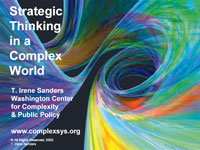
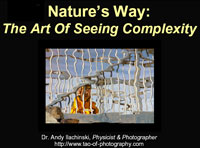
Smithsonian Course on Complexity Held May 2004In collaboration with the Resident Associate Program of the Smithsonian Institution, the Center presented Strategic Thinking in a Complex World during the month of May 2004. This groundbreaking one-month course was designed to give participants a working knowledge of complexity science with practical applications to life, work and world events.
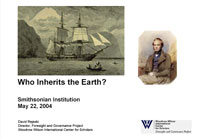
Working with both scientific and artistic collaborators, this course incorporated a variety of methods and media including—photography, art, music, dance, and architecture. Guest collaborators included: Andy Ilachinski, PhD, physicist/photographer; Symmes Gardner, director, Center for Art and Visual Culture, University of Maryland Baltimore County; and David Rejeski, director, Foresight and Governance Project, Woodrow Wilson International Center for Scholars.
"This interdisciplinary course will stretch your thinking and aesthetic sensibilities. Through the exploration of complexity, you'll see the world in new ways."
Angelo S. Ioffreda
VP, Internal Communications
Sodexho USA
Center Releases Landmark Report on the Use of Complexity Science
On October 28, 2003 the Center released a landmark report, The Use of Complexity Science: A Survey of Federal Departments and Agencies, Private Foundations, Universities, and Independent Education and Research Centers.The authors found that the use of complexity science and its state-of-the-art technologies for research and policy planning purpose has been growing rapidly since 9/11. The report shows that ten out of fifteen federal departments are involved in complexity science research and identified three broad categories of complexity science activity overall: research, business and education. Very few federal departments or agencies, however, are using complexity-based approaches in a "strategic" sense--to address broad system issues and challenges.
As the first survey of its type, it is not intended to present a comprehensive view of all that it is taking place. It will, however, give the reader a big picture sense, a broad sampling of how complexity science is being used in the United States. The survey was funded by the U.S. Department of Education at the request of Secretary Rod Paige. Click here to read the News Release. For more information contact Irene Sanders, 202-429-3733 or email info@complexsys.org.

|
|
Complexity and Defense Logistics
Vice Admiral Keith Lippert, director of DoD's Defense Logistics Agency (DLA), invited the Center's executive director, T. Irene Sanders, to be the luncheon speaker on November 6, 2003 at a meeting of the Agency's senior officers, Combatant Commanders and the service-specific Chiefs of Logistics. Her presentation, What's Complexity Got to Do with It? , described the value of using a complex adaptive systems framework to understand the current national security environment and the challenges facing DLA in fulfilling its worldwide mission. DLA provides wide-ranging logistical support for peacetime and wartime operations, as well as emergency preparedness and humanitarian missions.

Bang! Getting Your Message Heard in a Noisy World
Bang! a new book by Linda Kaplan Thaler and Robin Koval (with Delia Marshall), of the Kaplan Thaler Group (KTG), uses quotes from the Center's executive director, Irene Sanders, throughout the book to emphasize the importance of chaos and nonlinear thinking to the creative process. KTG developed the AFLAC duck commercials, the "Kodak moment" and Herbal Essences' outrageous "Totally Organic Experience" and is ranked as the fastest-growing advertising agency in the United States. Published 10/03 by Doubleday.
http://www.amazon.com/exec/obidos/ASIN/0385508166/
ref=pd_ecc_rvi_1/103-3943251-6787032

Manual Baez, Cubic Complexity, 2002-2001, 3 x 3 x 3 feet, bamboo sticks
and rubber bands.

David Goldes, Jar
1998, silver gelatin
courtesy of Yossi Milo
Gallery, New York
Complexity Science Media Center
As part of its commitment to promote complexity science literacy, the Washington Center for Complexity and Public Policy has established a Complexity Science Media Center. The Media Center will undertake a variety of multi-media educational projects designed to reach the broadest possible range of audiences. All projects will be coordinated by the Center and developed in partnership with interdisciplinary teams including scientists, artists and educators.
To celebrate its inauguration, the Center has developed an exciting series of events under the broad theme, The Art and Science of Complex Systems. These events are designed to tap the important relationship between art and science in order to make the basic principles, significance and real world applications of complexity science accessible to a wide audience.
In collaboration with the Fine Arts Program of the Federal Reserve Board, the Center sponsored, COMPLEXITY, September 26-November 28, 2003. This fine arts exhibit on complexity science included work from twenty-two artists. Examples can be seen on this page and in the Image Gallery section of this website.
In addition to reaching a large public audience, this exhibition allowed the Center to emphasize the important applications of complexity to public policy-making. Congressman Christopher Shays, co-chair of the Congressional Arts Caucus, and Betsi Shays served as Honorary Hosts for the opening of the exhibition in Washington, DC.
In May 2004 the Center presented a groundbreaking course in collaboration with the Resident Associate Program of the Smithsonian Institution. These innovative projects support the mutual interest of all collaborators in facilitating the integration of knowledge across disciplines and the practical applications of new learning that arise from such interactions. Our goal is to stimulate new thinking, provoke questions and encourage the desire to learn more.
people who master the new sciences of complexity will become the economic, cultural, and political superpowers of the next century.”
Heinz Pagels, PhD
Physicist
Traffic got you frustrated? Do you have the feeling that rush hour is really 24/7?
Is it possible that chaos theory and complexity science could help traffic engineers and planners in the Baltimore-Washington area find ways to ease your daily commute?Click here to learn more and to hear Traffic Jam a radio documentary featuring Irene Sanders, executive director of the Center, providing an explanation about how the new science is helping traffic engineers and policy experts find new approaches to transportation management.
Produced by Richard Paul, Soundprint, Media Center Inc. and funded by a grant from the National Science Foundation.

Click newspaper image
Counterterrorism: Nonlinear Thinking Needed
“Terrorists have the edge because the human mind is infinitely creative,” said Irene Sanders, executive director of the Center, in an interview with Investor’s Business Daily. “We need to think in a strategic, nonlinear way from the outset instead of only trusting what we’ve known from the past. That can mean starting with the most outrageous theory and working backward. In the Washington sniper case, all the profilers were wrong.”
These and other comments by Sanders were featured in an article by Peter Benesh, “Terrorist Acts, So Far Apart, Still Share Much in Common,” that appeared in the November 6, 2002 issue.
July 31, 2004. Irene Sanders will speak at the annual conference of the World Future Society, Creating the Future Now! The meeting is being held at the Grand Hyatt Washington in Washington, DC.
June 15, 2004. Irene Sanders will spend a week at the
e-Business Management School, Institute for Advanced Interdisciplinary Studies, University of Lecce, Italy, providing a series of lectures and seminars for the school's doctoral and masters degree candidates.April 17, 2004. Irene Sanders will speak at Complexity Science and the Exploration of the Emerging World, a one-day workshop sponsored by the Prigogine Center for Statistical Mechanics and Complex Systems, University of Texas at Austin.
February 6, 2004. Irene Sanders was the first speaker for, Addressing Complexity and Pursuing Cyber Security, a one-day workshop held at National Defense University and co-sponsored by the Washington Center for Complexity and Public Policy, the Cyber Conflict Studies Association, the Joint Task Force for Global Network Operations and the Center for Technology and National Security Policy.
.jpg)
Click to view full size
Center Releases Landmark Report on the Use of Complexity Science
9th Annual Public Issues Forum: A Dialogue on Science and Spirituality II - 3/29/03
Houston Non-profit to Host Visionary Irene Sanders 3/28/03
Home | About the Center | People | Seminars & Workshops |
News & Events | FutureScape | Image Gallery | Contact Us
© 2002 - 2008 Washington Center for Complexity & Public Policy
